Companies don't have to lie to you. They just have to put the button you're looking for where you won't find it, or ask the same question so many times that one day your thumb slips and you tap "Accept."
I've been noticing this in products I use every day. This post is the start: two cases I ran into myself.
I turned it off. But what, exactly?
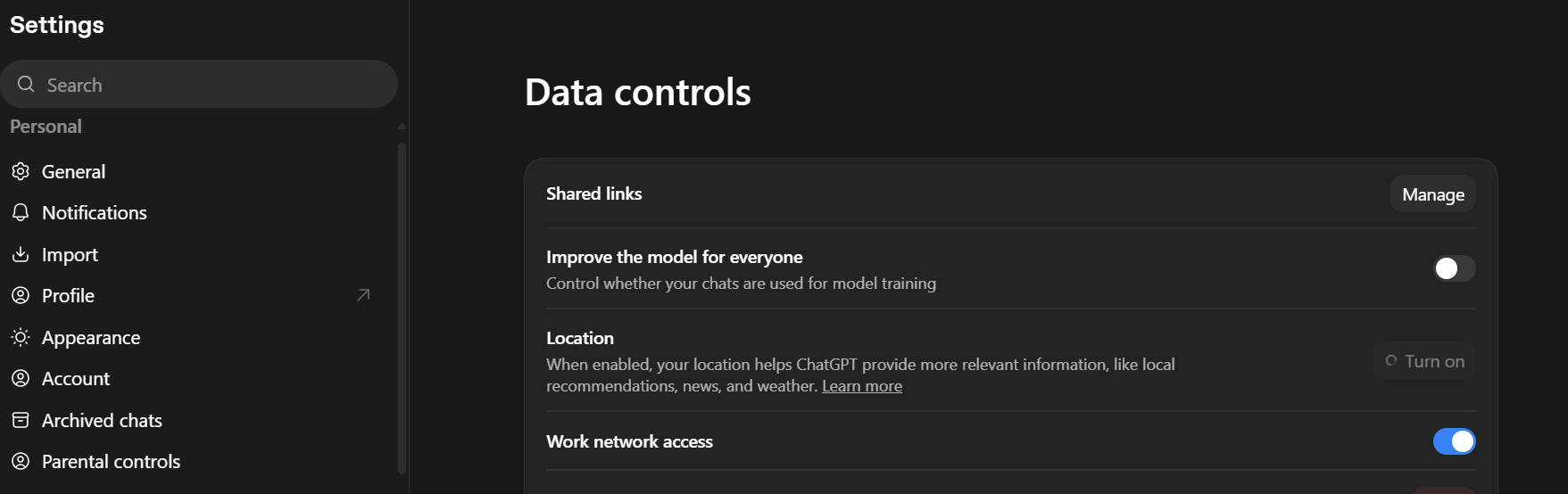
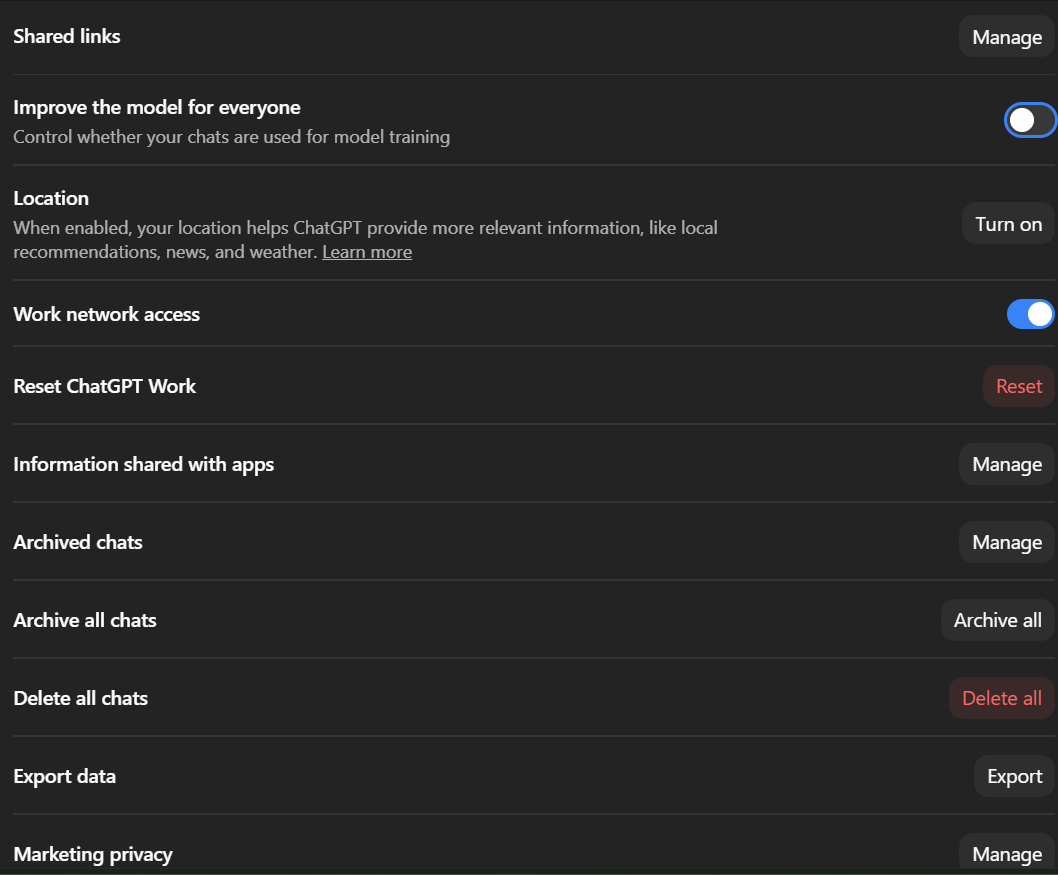
In ChatGPT, I wanted my data kept out of model training. I went to Data controls and turned off "Improve the model for everyone." Simple enough.
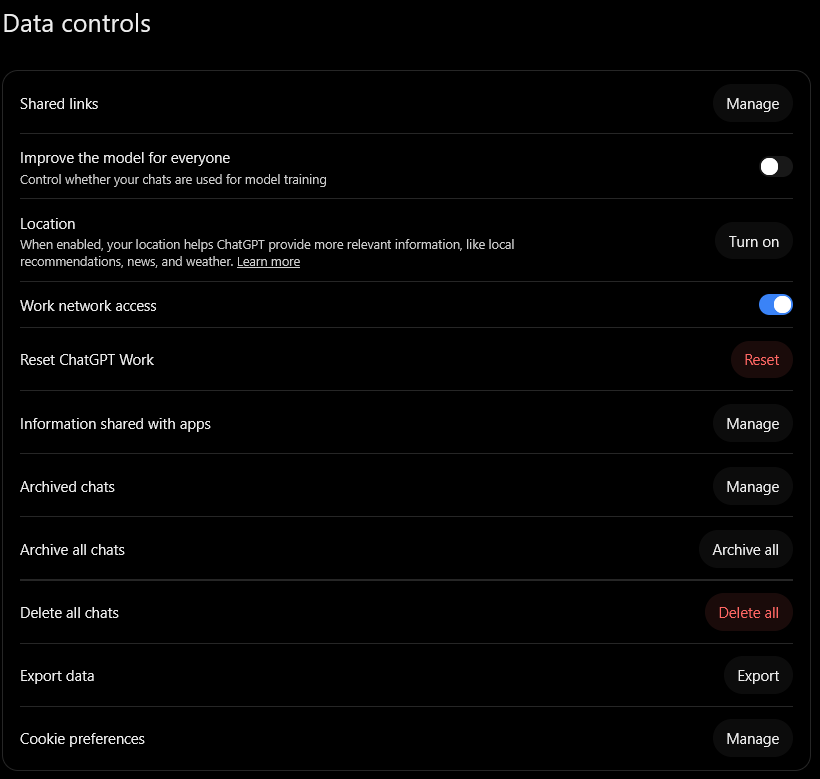
Screenshot from October 19, 2026. The general switch is off. There's no separate option for Codex environments here.
Then I went to OpenAI's own help pages. They say this general switch is enough for chats and Codex tasks. So far, so good. But then they mention a separate setting called Include environments, which decides whether additional context from Codex environments can be used for training. And they say turning off the general switch doesn't change this one.
So where is it? Every route we tried in the settings either led somewhere else or didn't have it. We finally reached the Codex Cloud settings page, which only manages execution environments.
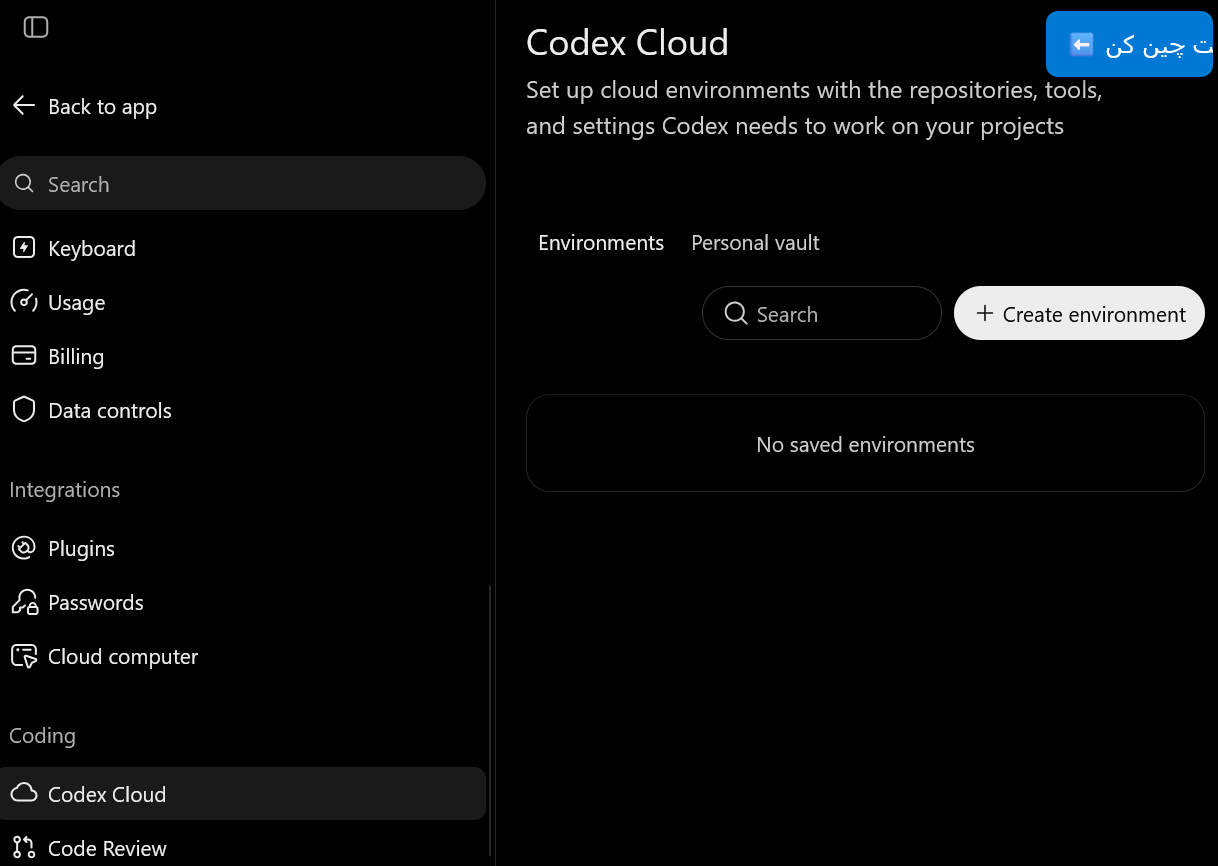
Screenshot from October 19, 2026. The last place we reached. Nothing about training or consent.
The result: I turned a switch off, and I still don't know whether I'm done.
Shahrzad’s note
Shahrzad:
To be fair, we haven't shown that OpenAI uses the data for training despite the switch being off. The help pages give a clear answer for chats and tasks. The ambiguity is only about the additional environment context: if the general switch is off and this one is on, which wins? We re-read both pages on October 22, 2026. (Data controls, How your data is used)
But that's exactly the problem. Someone who wants to say "no" shouldn't have to read help pages and dig through settings to find out what their "no" means, and still come away without an answer.
"No thanks," and the same question again
The second case is Google's. In Maps, I get this prompt:
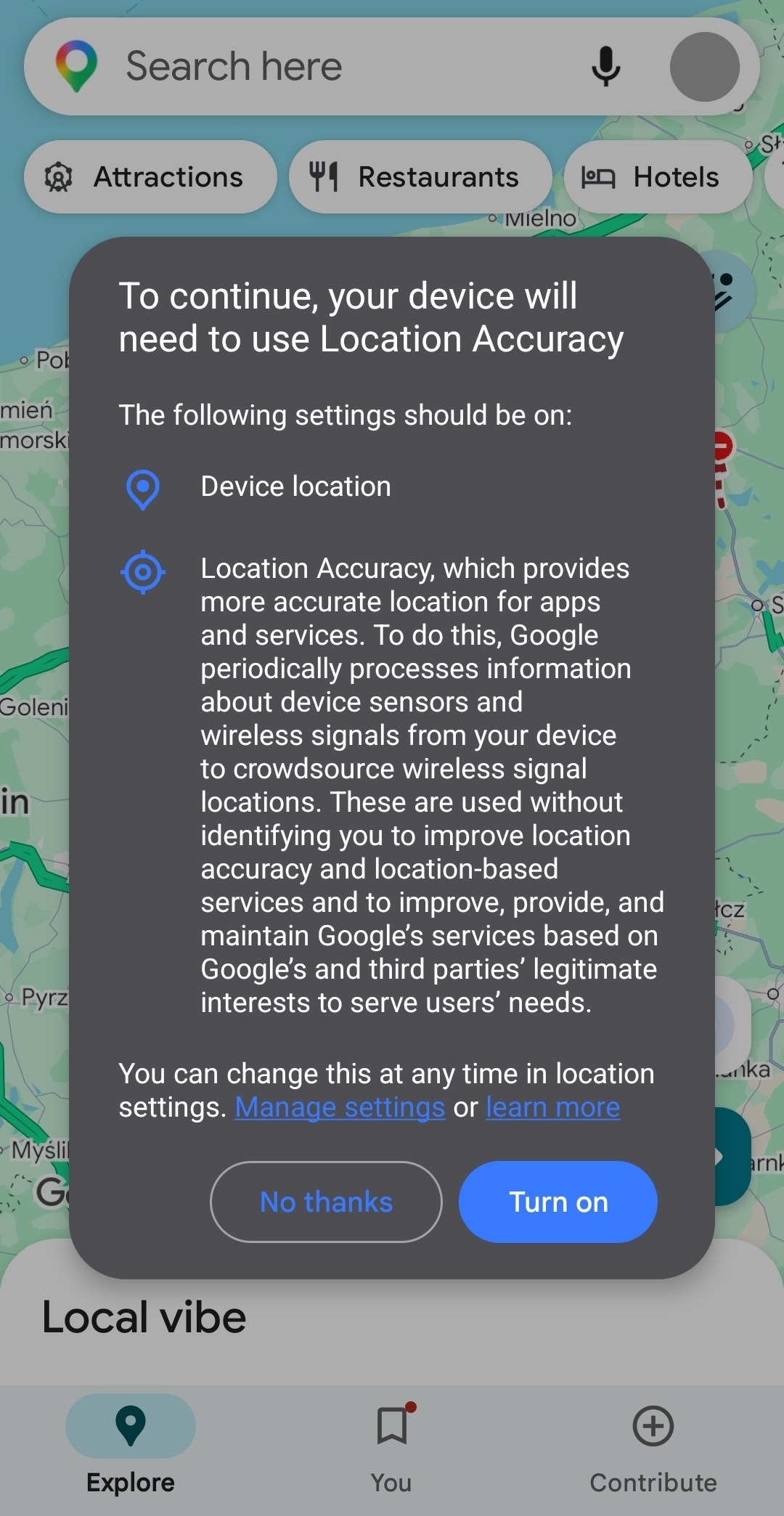
Google's Location Accuracy prompt, October 22, 2026.
It opens with "To continue, your device will need to use Location Accuracy." There is a "No thanks" button, but no "don't ask again." Every time I close Maps and clear it from memory, the same prompt is back the next time I open it. It keeps coming back until you either tap the wrong thing or give in.
There's something else in the text. One "Turn on" button both makes my own location more accurate and has my device regularly collect the wireless signals around me to improve Google's location database. Two different things, for two different beneficiaries, behind one button.
Shahrzad’s note
Shahrzad:
To be fair, Google has a technical reason too. It says Wi-Fi and other signals help where satellite signals are weak or blocked, for example indoors. The prompt also says the data is used without identifying the user. (Google's explanation)
But Arash's question isn't technical. If making my own location more accurate is one choice and helping Google's database is another, why accept both with one button? And if I said "no" once, why ask again?
What do we call this?
Asking again and again until the user gets tired and gives in has a name in design literature: nagging, one of the deceptive design patterns, or dark patterns. (Deceptive Design) The US Federal Trade Commission's report on these patterns gives the example of designs that "repeatedly prompt consumers to select settings they wish to avoid." (FTC report, 2022) The EU's Digital Services Act, in Article 25, lists "repeatedly requesting that the recipient of the service make a choice" that has already been made among the practices the European Commission may issue guidance against. (DSA, Article 25)
This isn't new for Google either. Google's repeated location prompts were catalogued as a deceptive pattern back in 2015. (Deceptive Design) And last month, on September 21, 2026, Ireland's Data Protection Commission fined Google €403 million. Location Accuracy was one of the three features in that case, and transparency was a problem common to all three. (DPC announcement)
Shahrzad’s note
Shahrzad:
None of this is a ruling on today's prompt. The Irish case covers 2018 to 2020, the FTC report gives general examples, and Article 25 doesn't apply everywhere or to every repeated prompt. But it shows that what Arash feels isn't just one annoyed user's impression. It has a name, a history, and regulators take it seriously.
I'm not saying every bad interface hides a sinister plan. Maybe the settings moved, maybe it's a bug, maybe it's just badly designed. But for the user the result is the same: you either get tired and give up, or one day your thumb slips and you agree to something you didn't want. At that point, intent doesn't matter. Transparency does.
Being transparent isn't hard. Give each consent its own button. Let "no" mean no, and don't ask again until I come back on my own. And after every choice, show me somewhere exactly what was saved.
Coming next
The list goes on: Gemini and what turning off history actually turns off, Samsung and per-app internet access, and a few more. I'll write each one when its evidence is complete.